The Science Behind Stress Interruption
It’s the very nature of life that this too will end.
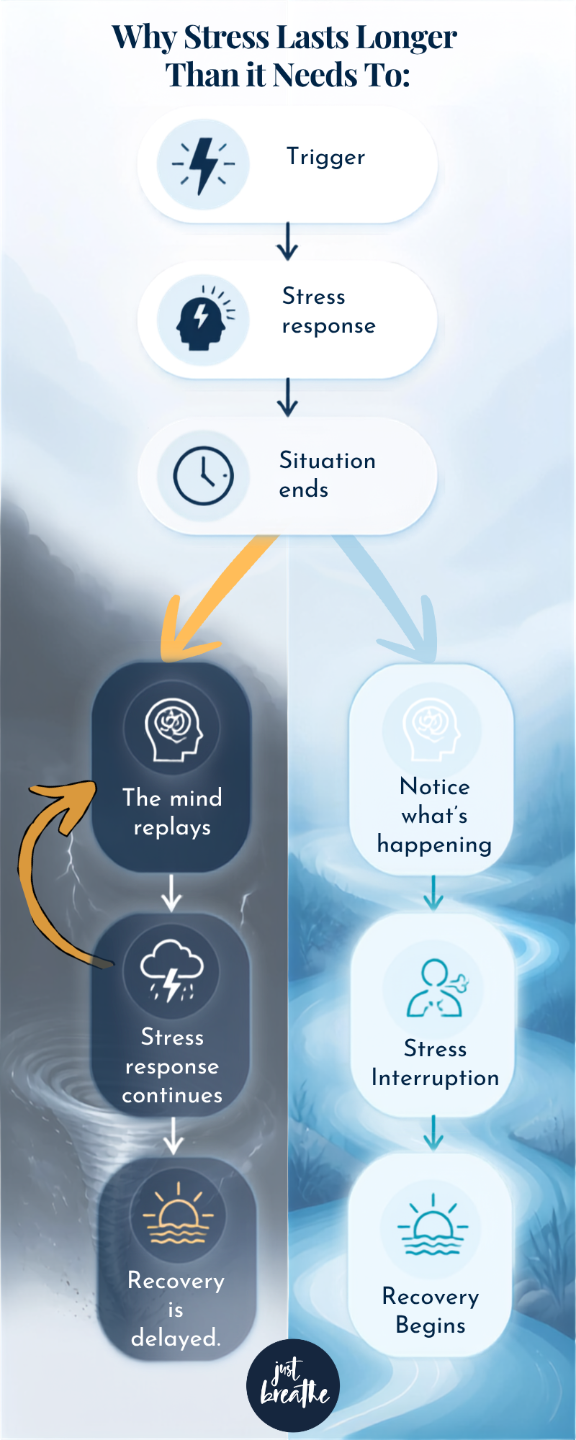
Why Stress Lasts Longer Than It Needs To
And so it ends...
- That stressful meeting finally comes to an end.
- The challenging conversation is finished.
- The medical appointment is over and
here we are at last, facing a moment to sigh it all out.
If only it ended there.
If only we could embrace the peace and enjoy it whole heartedly.
For many of us, this is when the mind takes over - replaying or questioning everything that's gone before. It imagines what comes next and finds lots of solutions for these future problems, we may never have.
These emotional imprints last long after the situation has passed and some of that experience comes home with us. As our mind settles in to the usual thinking, we don't realise that far from being harmless, for the body, we’re still living in a state of threat.
Sometimes we change our external world, but then I began to notice that this brought only temporary relief. Even when life became peaceful, my mind invented new things to worry about. My life became calmer on the outside, but my brain just wasn’t ready to retire. It simply found new reasons for me to worry.
I often wondered whether these thoughts were capable of wearing us out?
So, was it just me?
How was everyone else coping when I couldn’t?
And then.... the turning point.
In mindfulness, for the first time ever, I was able to experience a stillness in the mind.
I wanted to know exactly how this worked and I stopped asking whether it was possible to live without stress.
I started asking whether it was possible to spend less time living in it.
The more I explored stress, the more I realised something important. It wasn't always the stressful event that kept people trapped—it was what happened after the event had ended.
Why I Began Asking Different Questions
Before teaching mindfulness, I worked in technology for more than thirty years. Like many workplaces today, it was fast-paced, with deadline after deadline, responsibility and constant change. Thinking about work in the evenings and at the weekend became a very familiar activity. It was one I assumed was simply part of being successful.
When I began teaching mindfulness, I had an epiphany. It became clear that regardless of people's age, career or background, they all had a familiar story.
People spoke about
- struggling to switch off, rest and sleep
- replaying conversations over and over
- worrying about whether they should have done something differently
- the meeting they couldn't stop analysing
- the endless rehearsing of future events to solve problems that hadn't happened yet.
For some, the after-effects of an event that had lasted a few moments, could hang around for hours, days or even weeks.
The more people I met, the more I realised that my experience wasn't unique. - It was a pattern.
It was one that I'd lived for decades. It left me wondering whether we were asking the wrong question.
Perhaps the goal wasn't to eliminate stress altogether.
Perhaps the more interesting question was this:
Why do some people recover from stress more quickly than others?
I eventually realised that I wasn't researching stress management.
I was researching something different.
Stress Interruption.
Stress Interruption is the practice of recognising when stress continues after the trigger has passed—and gently interrupting the patterns that keep it alive.
That curiosity became the foundation of my postgraduate research, on my MSc in Mindfulness at the University of Aberdeen.
Could people learn to notice the early signs of stress and recover using simple mindfulness practices.
The research findings reinforced something I'd witnessed for years. We don't always get to choose what happens to us but maybe what happens next, is more within our gift than we realise.
Let’s Look at Stress Differently
It definitely warranted detailed research, after all:
When two people experience exactly the same situation, why will one cope whilst the other seems overwhelmed?
That’s one of life's big questions and can take us down many rabbit holes. We’ll find many valuable explanations in Psychology linked to our early experiences, personality, beliefs and life history. These all contribute to how we experience the world and understanding them can be an important part of coming to know ourselves more deeply.
Mindfulness uses a different filter, one which I explored during my research and years of teaching.
Regardless of how we arrived here, what can we do now?
Mindfulness gently shifts our attention away from analysing the past and towards noticing what is happening right now.
Not because the past doesn't matter.
But because the present is where we can begin to influence what happens next.
Why the Mind Keeps Churning
So if we're going to plant something new, where do we begin?
Surprisingly, with something we already do around 20,000 times a day.
Our breath.
It's hard to imagine something as ordinary as the breath could help us to recover from stress, but it's straightforward when we understand how our brains work.
Wired for Survival
If you've heard that we’re wired for survival, you may be wondering what that actually means in every day life.
It's all about our survival. Our brains constantly scan our environment for any signs of threat. This isn't analysis from the thinking brain, it's the nervous system asking one simple question:
"Am I safe?"
When we don't hear a definite "yes"; our attention goes into overdrive, trying to solve the problem. Unfortunately, the brain doesn’t just respond to what’s happening outside of us, it also monitors what happens within.
Thoughts!
- Thoughts about a conversation.
- Predictions about what happens next.
But why can thinking become so exhausting?
It’s our wiring. Our brains are trying to solve a problem that cannot be solved.
Uncertainty.
We want to be certain about
- Our health.
- Our children.
- Our work.
- Our relationships.
But uncertainty is part of the human condition.
Here’s the irony.
The very thinking we do to help us feel safe has the opposite effect.
The more we replay, the more we predict, the more we search for certainty, the more alert our brain becomes. In fact in generates even more thoughts in an attempt to solve the problem.
More thinking – doesn’t solve it and that famous advice – just stop worrying – sadly that won’t work either.
Most of us don't realise how much energy thinking actually consumes until life forces us to stop. Burnout can shine a light on something that’s been happening in the background all along. Whilst our bodies were sitting safely at home, our minds were still attending yesterday’s meeting; replaying a difficult conversation or trying to solve tomorrow’s problems.
So Why is Mindfulness Different?
Mindfulness doesn’t try to compete with our thoughts, to tame them or alter them. It gently moves our attention somewhere else.
It moves it to the present where it can rest on the breath.
This allows us to be present with our experience without it carrying us away.
But can it be that easy?
The short answer is no, because as we've seen, the brain is constantly scanning and getting distracted.
So we need to invite the brain to rest - a home for our attention.
The breath offers exactly that.
Instead of following every thought wherever it leads, we gently return to something that is already there, the breath.
As we gently balance the in-breath and the out-breath, something else begins to happen. Our nervous system also receives the message that, in this moment, we are at ease.
Now the brain will still wander! It’s trained that way.
The good news is we can teach the brain this new skill.
We simple practice resting our attention on the breath.
Every time we notice that we've become caught in worry, rumination or mental rehearsal we gently invite our attention to rest on the balanced breath.
It's Neuroscience
We practice this again and again until eventually, the brain learns a new habit.
A habit that becomes so familiar that we can use it when we find ourselves getting caught up in stress.
We don’t have to dig up every weed in the garden, we simply plant
new seeds that grow into,
new habits and overtime,
these gently replace our old ones.
This is the true power of mindfulness and why research continues to grow.
Mindfulness is not about turning off our thoughts.
We don’t stop thinking.
We simply learn to recognise when our thinking has stopped being helpful.
That small interruption gives us an opportunity to let go, return to the present and reclaim comes of the capacity that stress quietly takes from us.
Not once.
But hundreds of ordinary moments, repeated over a lifetime.
The Stress Interruption Method
The Stress Interruption Method pulls all of these themes together, developing a practical solution to the demands of today’s world.
It doesn’t promise to eliminate stress, it recognises that whilst stress is inevitable, being continually trapped in it, doesn’t need to be.
This is the cycle we can interrupt for both short and long term change
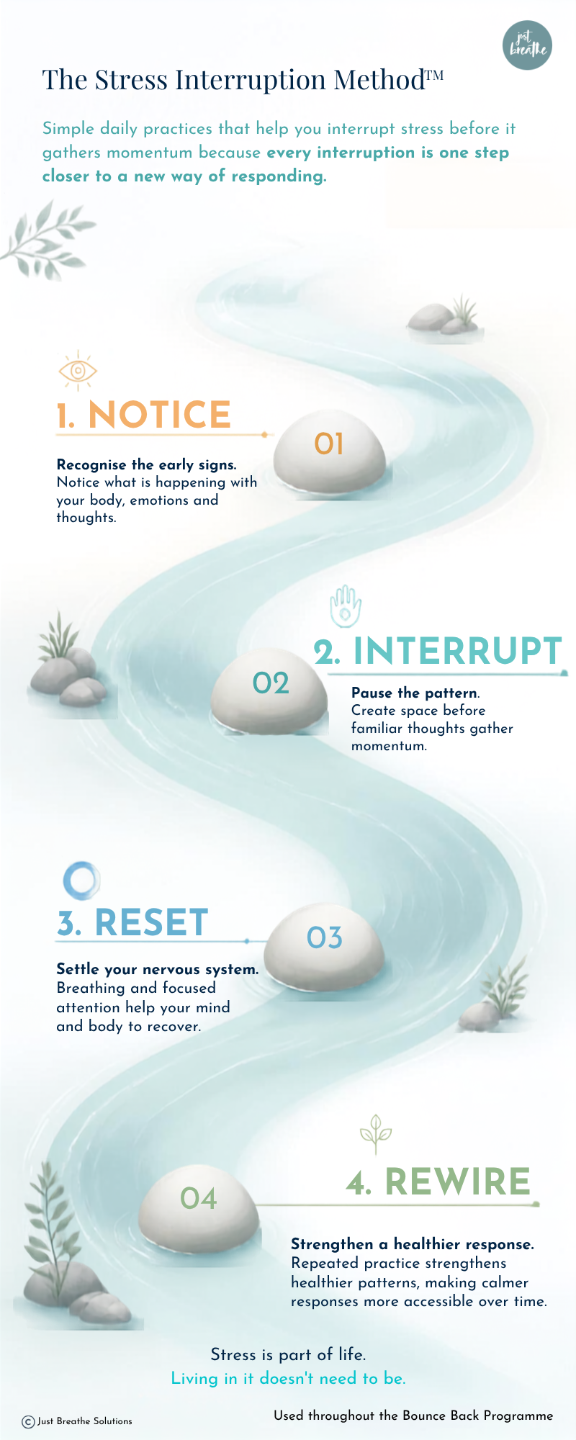
NOTICE
Recognise the early signs of stress.
Stress doesn't appear out of nowhere. It shows up in our thoughts, emotions and bodies long before we're fully overwhelmed. Learning to notice these early signals is the first step towards change.
INTERRUPT
Pause the automatic pattern.
Rather than allowing familiar thoughts to gather momentum, we learn to gently interrupt the process. This creates a small but powerful space between the trigger and our habitual reaction.
RESET
Help the nervous system recover.
By bringing our attention to the breath and anchoring ourselves in the present moment, we begin to settle the nervous system. As the body starts to feel safe again, the thoughts that would normally prolong stress naturally lose some of their grip.
REWIRE
Strengthen a new way of responding.
Every interruption is practice. With repetition, these new patterns become stronger and more automatic, helping us recover more quickly and respond to life's challenges with greater awareness and choice.
Research Behind the Stress Interruption Method
With a forty year history in stress reduction, Jon Kabat Zinn’s Mindfulness Based Reduction course was a critical part of my research, as was the modern work place take on mindfulness - Google's Search Inside Yourself.
The research included a critical review of thousands of papers, just to determine how much practice time would be required to have a practical impact on the stress response system.
Unlike other programmes, the approach considered learning within a calming environment and providing education on how it worked, to motivate the followers.
As part of the research I developed and evaluated a structured 21-day programme that explored whether daily mindfulness practice and stress education could help participants reduce their experience of stress. It became the foundation of The Bounceback Programme.
The Approach
Participants completed questionnaires about their daily exposure to stressful feelings, emotions and thoughts. They attended weekly qualitative interviews describing their personal experiences, ensuring that we understood their particular flavour of stress instead of matching their experience to preconceived ideas.
The research examined changes in perceived stress, emotional wellbeing and participants' relationship with their thoughts and reactions.
One finding stood out.
Many participants did not describe life becoming less busy - they described recovering more quickly from stressful situations.
- They noticed stressful patterns sooner and were able to intercept them before they escalated.
- They found it easier to step out of spiralling thoughts.
- They experienced greater emotional clarity.
Perhaps most importantly, they discovered that stressful moments did not have to define the rest of their day. By their very nature, these situations come and go.
Over 80% of participants reported meaningful benefits following the programme.
While no single study provides all the answers, the findings support what many mindfulness researchers have suggested for years: developing awareness can create opportunities for choice.
This mindful choice is the very foundation of the Stress Interruption Method.
What This Means in Everyday Life
Stress Interruption isn't reserved for major life crises - instead it happens in ordinary moments.
- Closing your laptop without carrying work into the evening.
- Not replaying a conversation throughout the school run.
- Sleeping more peacefully after receiving an unexpected email.
- Recognising anxious thoughts before they gather momentum.
- Returning your attention to the present while waiting for difficult news.
- Choosing kindness over self-criticism after making a mistake.
Because how we live from hour to hour becomes how we live year to year.
These moments may be small, but over weeks, months and years, they shape how we experience our lives.
A gentle reminder:
Stress may visit all of us.It doesn't have to move in.
If you'd like a reminder of these ideas during the week, I've created a free Stress Interruption Companion Guide that you can keep and return to whenever you need it.
Download the Stress Interruption Companion GuideReady to Experience the Method?
Understanding why stress lingers is the first step.
Learning to recognise it in your own life is where change begins.
The Bounce Back Programme takes you through the Stress Interruption Method over 21 days, combining short daily lessons, guided mindfulness practices and the research you've just read about.
Start the Bounce Back Programme
Frequently Asked Questions
Is Stress Interruption simply another name for mindfulness?
No.
Mindfulness provides many of the skills that support Stress Interruption, but the method focuses specifically on recognising and shortening the cycles that keep stress active after a triggering event. You can experience this through the Bounce Back Programme.
Does this mean stress is "all in our heads"?
Not at all.
Stress involves the whole person—our nervous system, body, emotions, environment and experiences.
The method simply recognises that our patterns of attention and thinking can sometimes prolong stress after the original trigger has passed.
Can anyone learn these skills?
Yes.
Like learning any new habit, the skills become more familiar through gentle, repeated practice rather than through willpower.
Is this therapy?
No.
Stress Interruption is an educational and wellbeing approach informed by mindfulness research. It is not a replacement for medical or psychological treatment where this is needed.
Continuing the Research
Stress Interruption continues to evolve through teaching, participant feedback and ongoing research.
My hope is that this work contributes to a wider conversation about stress, resilience and the practical application of mindfulness in everyday life.
If we can recognise stress earlier, interrupt unhelpful patterns more quickly and return to the present with greater ease, we may not remove life's challenges—but we can reduce the amount of time we spend living inside them.
Because while stress is part of being human, living in it doesn't need to be.
Explore the Bounce Back Programme